Shaheen Bagh Protests: Behind the Scenes

Background of protests:

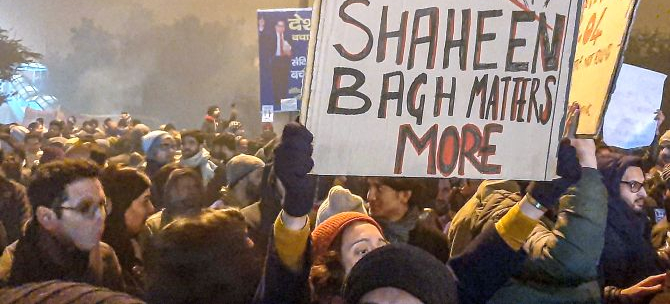
The Shaheen Bagh protest is an ongoing 24/7 protest being held at Shaheen Bagh, South Delhi. It began with the passage of the Citizenship (Amendment) Act (CAA) on 11 December 2019 and the ensuing police intervention against students at Jamia Millia Islamia who were opposing the Amendment.

Protest mainly consists of Muslim women. They have blocked the Kalindi Kunj-Shaheen Bagh stretch (highway) in New Delhi. It has now become the longest ongoing continuous protest against CAA-NRC-NPR (more than 50 days).

Nature of the protest:

It is said that it is a non-violent protest. People there are not using any force. They are just sitting and protesting.

But in the backdrop of this protest, people are inciting the crowd. They are raising anti-national slogans. They are talking about cutting off state/states (for example Assam) from rest of India. They are talking about violence. They are threatening journalists and other people coming to the protest site.

Is it really a peaceful protest?

Suppose people there are not following violence and they are using their Fundamental Right of Freedom of Speech and Expression and propagating their views. In those views they are talking about violence. Is it not equivalent to creating a violent atmosphere? Or our definitions of “spreading violence” have become so shallow that we cannot even see whether it is really violent or not.

A peaceful protest is peaceful by thoughts as well as by actions. The greatest example is the thought process and actions of the Father of the Nation Mahatma Gandhi Ji. But here the story is entirely different. They are thinking (probably not even thinking) that they are being peaceful but in actions they are spreading violence by using their soft power, power of words.

In layman term- it is not a peaceful protest, it is just an eyewash on the face of “being peaceful”.

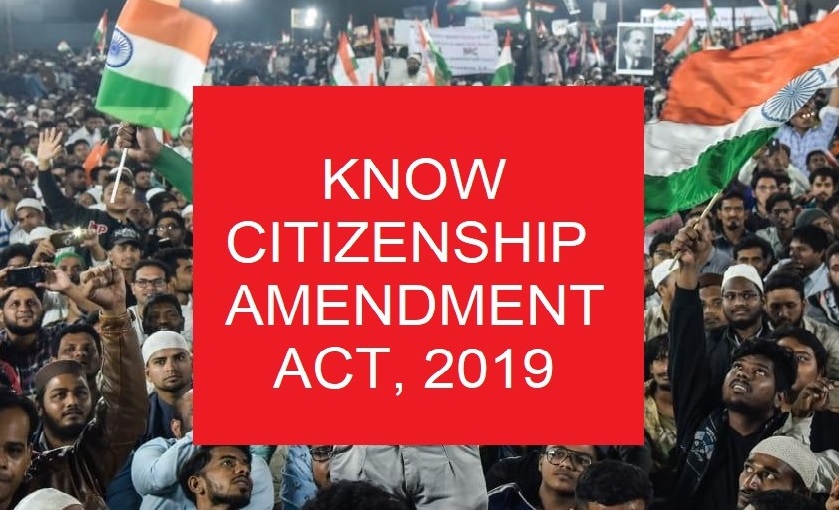
Is Citizenship (Amendment) Act, 2019 against Muslims?

The fundamental criticism of the Citizenship Amendment Act, 2019 has been that it specifically targets Muslims. This article tries to explain key aspects of this criticism.

It is being said that it fails to allow Muslims from our neighbour countries (Pakistan, Afghanistan, Bangladesh and Myanmar), who also face persecution, to apply for citizenship. Let us understand how it is not the true.

  • Ahmediyas and Rohingyas:
    • If they enter India with valid travel documents, they can still seek Indian citizenship through naturalization.
  • Shia Muslims
    • If they are facing persecution and seeking shelter in India, their case to continue to reside in India as a refugee shall be considered on its merits and circumstances.
  • Balochi refugees:
    • Including Balochis in the CAA could be perceived as interference in Pakistan’s internal affairs as they have long history of their struggle for independent Baluchistan against Pakistan.

Thus CAA does not exclude Muslims from neighbour countries to apply for Indian citizenship. They can still apply for the citizenship in the same way singer Adnan Sami, for example, applied.

Also, according to Harish Salve (one of India’s biggest names in national and international law), the Citizenship Amendment Act is not anti-Muslim.

  • Harish Salve stated that the countries specified in the CAA have their own state religion. They also have their own Islamic rules. He added that Islamic majority nations identify their people as per who follows Islam and who does not. Addressing governance problems in neighboring countries is not the purpose of the CAA.
  • Over the issue of Rohingyas, Harish Salve stated that a law that addresses one evil does not need to address all the evils in all countries. It is notable here that Myanmar, though a Buddhist majority nation, does not have a state religion and Myanmar does not feature in CAA.

Hence we should understand that CAA, 2019 is an act to grant Indian Citizenship, not to snatch it. We should keep ourselves away from unnecessary criticism.

Real Facts on Citizenship (Amendment) Act, 2019


Do not get misled, do not fall victim to misinformation.
Here are the real facts on Citizenship (Amendment) Act, 2019
:


Q1. Is NRC a part of the CAA, 2019?

Ans: No. CAA is a separate law and NRC is a separate process. The CAA has come into force nationwide after its passage from Parliament, while the NRC rules and procedures for the country are yet to be decided. The NRC process that is going on in Assam has been implemented by the Honorable Supreme Court and mandated by the Assam Accord, 1985.

Q2. Do Indian Muslims need to worry about CAA or NRC?

Ans: There is no need for an Indian citizen of any religion to worry about CAA or NRC.

Q3. Will NRC be for people of a particular religion?

Ans: No. NRC has nothing to do with any religion at all. NRC is for every citizen of India. It is a citizen register, in which names of every Indian will be recorded.

Q4. Will people be excluded from NRC on religious grounds?

Ans: No, NRC is not about any religion at all. Whenever NRC is implemented, it will neither be applied on the basis of religion nor be implemented on the basis of religion. No one can be excluded from NRC just on the basis that he follows a particular religion.

Q5. By conducting NRC, will we be asked to present proofs of us being Indian?

Ans: First of all, it is important to know that at the national level, no announcement has been made to begin NRC process. If it is implemented, it does not mean that anyone will be asked for proof of being Indian. NRC is merely a normal process to register your name in the Citizens’ Register. Just like we present our identity cards or any other document for registering our names in the voter list or getting Aadhaar card made, similar documents shall need to be provided for NRC, as and when it is carried out.

Q6. How is citizenship decided? Will it be in the hands of government?

Ans: Citizenship of any person is decided on the basis of The Citizenship Rules, 2009. These rules are based on the Citizenship Act, 1955. This rule is publicly in front of everyone. These are five ways for any person to become a citizen of India:

  1. Citizenship by Birth,
  2. Citizenship by descent,
  3. Citizenship by registration,
  4. Citizenship by naturalization,
  5. Citizenship by incorporation

Q7. Will I have to provide details of birth of parents etc. to prove my Indian citizenship?

Ans: It would be sufficient for you to provide the details of your birth such as date of birth, month, year and place of birth. If you do not have the details of your birth, then you will have to provide the same details about your parents. But there is absolutely no compulsion to submit any document by the parents. Citizenship can be proved by submitting any documents related to date of birth and place of birth. However, a decision is yet to be taken on such acceptable documents. This is likely to include voter cards, passports, Aadhaar, licenses, insurance papers, birth certificates, school leaving certificates, documents relating to land or home or other similar documents issued by government officials. The list is likely to include more documents so that no Indian citizen has to suffer unnecessarily.

Q8. Do I have to prove ancestry dating back before 1971?

Ans: No. For pre-1971 genealogy, you do not have to submit any type of identity card or any documents like birth certificate of parents / ancestors. It was valid only for the Assam NRC, based on the ‘Assam Accord’ and the directive of the Honourable Supreme Court. For the rest of the country, the NRC process is completely different and under The Citizenship (Registration of Citizens and Issue of National Identity Cards) Rules, 2003.

Q9. If it is so easy to prove identity, then how 19 lakh people in Assam were affected due to NRC?

Ans: Infiltration is an old problem in Assam. To curb it, there was a movement and in 1985, the then Rajiv Gandhi government, to identify the intruders, had to enter into an agreement to prepare NRC, assuming the cut-off date of 25 March 1971.

Q10. During NRC, will we be asked to present old documents, which are difficult to collect?

Ans: There is nothing like that. Common documents will only be required to prove identity. When the NRC is announced at the national level, then rules and instructions will be made for it in such a way that no one will face any trouble. The government has no intention of harassing its citizens or putting them in trouble!

Q11. What if a person is illiterate and does not have relevant documents?

Ans: In this case, the authorities will allow that person to bring a witness. Also, other evidence and community verification etc. will also be allowed. A proper procedure will be followed. No Indian citizen will be put in undue trouble.

Q12. There are a large number of people in India who do not have homes, are poor and are not educated and they do not even have any basis of identity. What will happen to such people?

Ans: This is not entirely correct. Such people vote on some basis and they also get the benefit of the welfare schemes of the government. Their identity will be established on the basis of that.

Q13. Does NRC exclude anyone for being transgender, atheist, adivasis, dalits, women and landless without / without documents?

Ans: No. NRC, as and when carried out does not affect any of the mentioned above.

Read, understand and form your own judgment regarding this issue, rather than falling prey to vested interests
Hate Speech & Indian Politics

Article 19(1)(a) of the Constitution of India confers upon the citizens of the country, the right to freedom of speech and expression. The ability to express our opinion and speak freely is essential to bring about change in society. However, striking a balance between freedom of expression and prohibition of hate speech is a complex challenge.

What is Hate Speech?

The Constitution of India and its hate speech laws aim to prevent discord among its many ethnic and religious communities. The laws allow a citizen to seek the punishment of anyone who shows the citizen disrespect “on grounds of religion, race, place of birth, residence, language, caste or community or any other ground whatsoever”. The laws specifically forbid anyone from outraging someone’s “religious feelings”. However the term ‘Hate Speech’ is not defined under Indian law. Unlike England, South Africa, Canada, and other western European nations, there is a dearth of any specific legislation on these Hate Speech in India. There are various provisions of Indian Penal Code, 1860 and Representation of the People Act, 1951 that try to provide punishment and relief against hate speech.

Provisions under Indian Laws

Under Indian Penal Code, 1860:

·         Section 153A; penalizes promoting enmity between different groups on grounds of religion, race, place of birth, residence, language, etc., and doing acts prejudicial to maintenance of harmony.

·         Section 153B; penalizes imputations, assertions prejudicial to national integration.

·         Section 295A; penalizes injuring or defiling place of worship with intent to insult the religion of any class.

·         Section 298; penalizes uttering, words, etc., with deliberate intent to wound the religious feelings of any person.

·         Section 505 (1) & (2); penalizes publication or circulation of any statement, rumor or report causing public mischief and enmity, hatred or ill-will between classes.

Under Representation of People Act, 1951:

·        Section 8 disqualifies a person from contesting the election if he/she is convicted for indulging in acts amounting to the illegitimate use of freedom of speech and expression.

·       Section 123(3A) and section 125 prohibits promotion of enmity on grounds of religion, race, caste, community or language in connection with election as a corrupt electoral practice and prohibits it.

Dark Side of Indian Politics

If you ask ten people as to what a clean election is, there will be ten different responses but amongst all, people insist on ‘clean candidates’ for the elections to be effective. Being the largest serving democracy, the elections do take place duly but every single time the purpose is not met. It is one of the disturbing features of India’s electoral democracy where candidates with tainted and tarnished image emerge out as the winners of these elections and we fail to have good leaders to take us forward and to keep at par with the other progressing States.

Conclusion

The political parties continue to field such candidates despite having serious criminal records against them. With the same MPs and MLAs contesting the elections again would be like old wine in new bottles. Therefore, candidates with past records of criminal charges must not be accepted. It is also necessary for media to play a pro-active role in disseminating information and making more and more people aware of their candidates to enable them to make a wise choice for a better tomorrow. If we really want to witness some changes, there is a need to identify the right people to stand for elections for a good governance.

Design a site like this with WordPress.com
Get started